
How to Price Products for Export from Nigeria and Ghana (2026 Complete Guide)

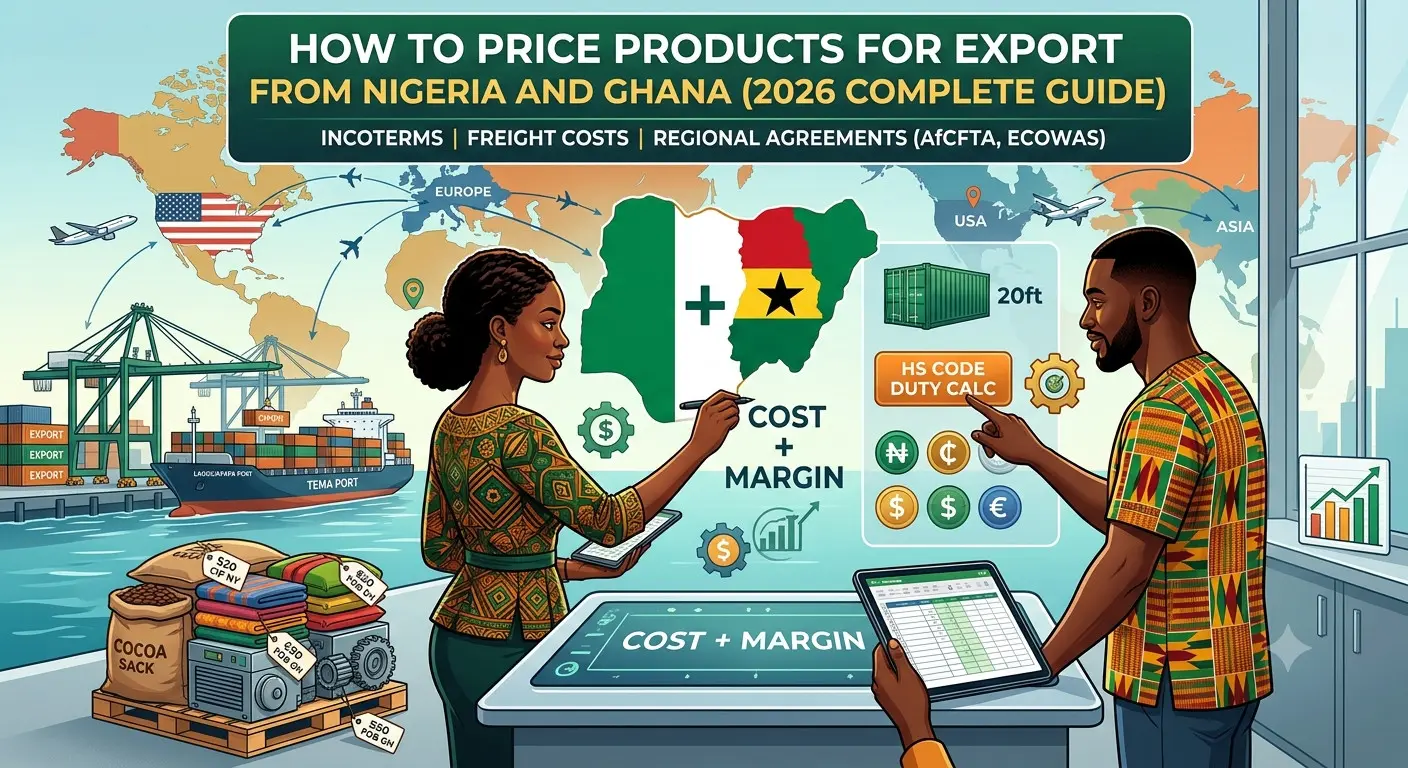
Pricing for export is one of the most important skills an African exporter can develop — and one of the most poorly understood. Most first-time exporters from Nigeria and Ghana make the same expensive mistake: they quote a price based on what they sell locally, add a rough guess for shipping, and hope for the best.
The result? They either price too high and lose the buyer to a cheaper supplier, or they price too low, absorb costs they didn’t account for, and sell at a loss without knowing it. First-time exporters who price based on production cost alone frequently sell unprofitably.
This guide walks you through how to price your products correctly for international buyers — covering every cost you need to account for, the international trade terms you will encounter (and what they actually mean), how to build a price that protects your margin, and how to present your pricing to buyers in a way that wins orders.
Why Export Pricing Is Different From Local Pricing
When you sell locally in Nigeria or Ghana, your costs are relatively straightforward: production, packaging, transport to the buyer, and your margin.
International pricing is more complex because there are more hands, more legs of the journey, more documentation, and more cost layers between you and the buyer — many of which first-time exporters have never factored in.
The full export cost equation includes: production; packaging; NEPC registration fees; NAFDAC/NAQS/SON inspection fees; certificate of origin fees; NXP form processing; NESS levy (1% of FOB value); freight forwarding fees; shipping; port charges; insurance; and bank charges for Letters of Credit or documentary collection.
Each of those line items eats into your margin. Ignore even two or three of them and a deal that looked profitable on paper becomes a loss by the time the goods clear the destination port.
Step 1 — Calculate Your True Production Cost Per Unit
Start from the ground up. Your production cost per unit for export is not the same as your local production cost, because export requires:
- Export-grade packaging — many buyers require specific labelling, carton specifications, or packaging that complies with the importing country’s standards. This often costs more than your standard local packaging.
- Quality consistency — export buyers expect every unit in every shipment to match the sample. Factor in quality control checks, testing, and rejection allowances.
- Batch production costs — if you are producing a larger volume for an export order, there may be additional raw material, labour, and overhead costs per batch.
Format your cost as a per-unit figure:
Production cost per unit: $X Export packaging per unit: $X Quality control per unit: $X Total ex-factory cost per unit: $X
This is your “EX Works” (EXW) cost — the price of the product at your factory gate, before any logistics.
Step 2 — Understand the Incoterms (The Language of Export Pricing)
When international buyers ask for a price, they will specify an Incoterm — a standardised trade term that defines exactly who pays for what between your factory and their door. Export pricing is often calculated using international trade terms known as Incoterms, such as FOB (Free on Board) and CIF (Cost, Insurance, and Freight). Understanding these terms helps you define who is responsible for shipping costs and risks at each stage of the transaction.
As a Nigerian or Ghanaian exporter, you will encounter three main Incoterms:
FOB — Free on Board
What it means: You are responsible for all costs until the goods are loaded onto the ship at your named export port (e.g., FOB Lagos, FOB Tema). Once the goods cross the ship’s rail, the buyer takes over — they pay for ocean freight, insurance to the destination, import duties, and delivery to their warehouse.
What you include in your FOB price:
- Ex-factory cost (production + packaging)
- Inland transport from your location to the port
- Export customs clearance and documentation
- Port handling and loading charges
- NESS levy (1% of FOB value — Nigeria-specific)
- Export agent/freight forwarder fees
FOB pricing is straightforward — you quote up to the port of loading. Once the cargo is on board, the buyer takes over freight, insurance, and downstream risk.
When buyers prefer FOB: Large, experienced importers who have their own freight contracts and want to control shipping costs. This is the most common term for B2B bulk trade.
CIF — Cost, Insurance, and Freight
What it means: You pay everything — production, export costs, ocean freight, AND insurance — until the goods arrive at the buyer’s named destination port. The buyer only takes over from their port.
What you include in your CIF price:
- Everything in your FOB price
- Ocean freight from your port to the buyer’s port
- Marine insurance for the shipment
When buyers prefer CIF: Smaller importers, first-time buyers, and buyers who are not familiar with arranging international freight. CIF simplifies the buying decision — they see one price and know exactly what they are paying. CIF offers maximum simplicity for the buyer — one price, one responsibility point at the destination port.
The catch for you as the seller: CIF means you are managing and paying for the ocean freight, which adds risk. If freight costs go up between quoting and shipping, your margin shrinks. Build in a buffer.
EXW — Ex Works
What it means: The buyer collects the goods directly from your factory and arranges everything from that point. You are only responsible for making the goods ready.
When to use it: Rarely appropriate for export from Nigeria or Ghana unless the buyer is very experienced, local, and has their own freight forwarding operation. Avoid quoting EXW to international buyers unfamiliar with Nigerian/Ghanaian logistics.
Step 3 — Build Your FOB Price (With a Real Example)
Let’s walk through a worked example. You produce black soap in Lagos and a buyer in the UK requests a FOB price for 500 units.
| Cost Component | Per Unit | 500 Units Total |
|---|---|---|
| Production (ingredients, labour, overhead) | $2.80 | $1,400 |
| Export packaging (cartons, labels, seal) | $0.40 | $200 |
| Quality control and testing | $0.20 | $100 |
| Ex-Factory Cost | $3.40 | $1,700 |
| Inland transport to Apapa port, Lagos | $0.25 | $125 |
| NEPC documentation fees | — | $80 |
| NAFDAC export clearance | — | $120 |
| Certificate of Origin | — | $45 |
| NXP form processing | — | $30 |
| NESS levy (1% of FOB) | — | ~$24 |
| Port handling and loading fees | $0.18 | $90 |
| Freight forwarder agent fee | — | $150 |
| Total Export Cost (pre-margin) | $4.73 | $2,364 |
| Your profit margin (25%) | $1.18 | $591 |
| FOB Price Lagos | $5.91 | $2,955 |
Your FOB quote to the UK buyer: $5.91 per unit, FOB Lagos, or $2,955 for 500 units FOB Lagos.
This is the price the buyer pays to get the goods on the ship. They then arrange and pay for ocean freight from Lagos to the UK (typically $800–$1,500 for a shared container) and UK import duties.
Step 4 — Build Your CIF Price
If the buyer prefers CIF, you take your FOB price and add:
- Ocean freight: Get a real quote from a freight forwarder for the specific route and volume. Do not guess. For 500 units of black soap (roughly 0.1–0.2 cubic metres), a groupage/LCL (Less than Container Load) rate from Lagos to the UK is typically $300–$600.
- Marine insurance: Standard rate is approximately 0.5–1% of the shipment value. On a $2,955 FOB shipment, that is $15–$30.
| Component | Amount |
|---|---|
| FOB Price (500 units) | $2,955 |
| Ocean freight (Lagos → UK, LCL) | $450 |
| Marine insurance (0.6%) | $18 |
| CIF Price (500 units) | $3,423 |
| CIF per unit | $6.85 |
Your CIF quote: $6.85 per unit, CIF Felixstowe/Southampton, or $3,423 for 500 units.
Step 5 — Account for the Costs Most Exporters Miss
Many businesses fail not because of lack of demand, but because they do not understand how to navigate export procedures correctly. Here are the specific costs that regularly blindside first-time exporters from Nigeria and Ghana:
NESS Levy (Nigeria): The NESS levy — Nigerian Export Supervision Scheme levy — is 1% of the FOB value of the exported goods, payable to Nigeria Customs at export. On a $2,955 FOB shipment, that is approximately $30. Small per shipment, significant over volume.
Pre-shipment inspection: Many importing countries — and many buyers — require pre-shipment inspection by bodies like SGS or Bureau Veritas before goods leave Nigeria or Ghana. This costs $150–$400 depending on shipment size and product type. Factor it in.
Weight loss and yield (agricultural products): If you export agricultural goods — cashews, shea, cocoa, sesame — there is often a natural weight loss between purchase, processing, and export. Drying the nuts and moisture loss adjustment, labour charges, weight loss, warehouse storage, transport, packaging, and loading fees all add up significantly between farm gate and FOB port price. Price after processing, not before.
Currency timing risk: Currency fluctuations can affect profits, so it is important to price products carefully and monitor exchange rates. If you quote in USD today and the rate moves significantly before you collect payment, your Naira or Cedi revenue changes. Build a small buffer (3–5%) into your price to absorb exchange rate movement, or use a payment term that fixes the rate (see below).
Bank charges: Wire transfers, Letters of Credit handling, and documentary collection all attract bank fees — typically 0.5–1.5% of the transaction value. Do not ignore these.
Step 6 — Pricing Strategy: Top-Down vs Bottom-Up
NEPC recommends calculating your export price using both methods: bottom-up (building outward from your ex-factory cost to the end consumer) and top-down (working backward from the ideal end market price). Both methods have their strengths, and calculating both gives you the optimal export pricing balance.
Bottom-up (what we’ve done above): Start from your production cost, add every export cost layer, add your margin, and arrive at your FOB or CIF price. This ensures you never sell below cost.
Top-down: Research what your product sells for at retail in the destination market. Work backward through the import chain — retailer margin (30–50%), distributor margin (15–25%), importer margin (10–20%), freight and duties — to find the price the importer can afford to pay you and still make money. If your bottom-up FOB price is higher than the top-down maximum, you either need to reduce costs or find a different market.
Use both: The bottom-up price protects your floor. The top-down price tells you whether the market can sustain a profitable deal at that floor.
Step 7 — Presenting Your Price to Buyers Professionally
The way you present your export price is as important as the price itself. A buyer comparing two suppliers will trust the one who gives a clear, documented quote.
A basic pro forma invoice or export price quote should include:
- Your full name and company, with NEPC registration number (if registered)
- Product name, HS code, and specifications (weight, grade, packaging)
- Unit price and quantity
- Incoterm and named port (e.g. “FOB Lagos, Nigeria”)
- Currency (always USD for Nigerian and Ghanaian export)
- Payment terms (e.g. “50% advance, 50% against Bill of Lading”)
- Validity period (e.g. “This quote is valid for 14 days from the date above”)
- Estimated lead time (e.g. “Ready to ship within 10 business days of confirmed order”)
A quote with these elements signals a professional exporter. A WhatsApp voice note with a rough figure signals an amateur — and the buyer will negotiate you down accordingly.
Getting Paid Safely
Pricing correctly means nothing if you cannot collect your payment. For Nigerian and Ghanaian exporters dealing with new international buyers: For first-time exporters, insist on Advance Payment or Letter of Credit. Shipping goods on Open Account to a new international buyer is the most common cause of catastrophic export losses for Nigerian businesses.
Advance Payment: Buyer pays 100% (or 50%) before you produce or ship. Maximum protection for you, highest resistance from buyers. Realistic for small or sample orders.
Letter of Credit (L/C): The buyer’s bank guarantees payment once you present the specified shipping documents. The gold standard of international trade — use it for large first orders with new buyers.
Escrow platforms: Marketplaces like Oka234 hold the buyer’s payment in escrow and release it to you once the buyer confirms receipt. This is the most practical solution for smaller B2B orders — it protects both sides without the complexity of a formal Letter of Credit.
Quick Reference — Export Price Checklist
Before submitting any export quote, confirm:
- [ ] Production cost calculated per unit at export volume (not local retail volume)
- [ ] Export packaging cost included
- [ ] Inland transport to port included
- [ ] All documentation fees included (NEPC, NAFDAC/SON, Certificate of Origin, NXP)
- [ ] NESS levy (1% of FOB) included (Nigeria)
- [ ] Pre-shipment inspection fee included if required
- [ ] Port handling and loading fees included
- [ ] Freight forwarder agent fee included
- [ ] Ocean freight included (for CIF quotes only)
- [ ] Marine insurance included (for CIF quotes only)
- [ ] Bank/payment processing fees included
- [ ] Currency buffer (3–5%) included
- [ ] Profit margin applied after all costs
- [ ] Incoterm and named port clearly stated in quote
- [ ] Quote validity period included (14–30 days)
List Your Products on Oka234 and Reach International Buyers
Once you have your export pricing structured, the next step is getting it in front of buyers. Oka234 lets you display tiered wholesale pricing — lower per-unit prices for larger quantities — directly on your product page, so B2B buyers can self-qualify and send you quote requests without lengthy back-and-forth.
Your first 50 products are listed for free by the Oka234 team, live within 72 hours. All pricing on the platform is in USD — consistent with everything you have built in this guide.
Create your free seller account on Oka234 →
Oka234 is a global B2B and B2C marketplace connecting African sellers to buyers in 180+ countries. List your products and reach verified international buyers today. Start for free →