
Best B2B Marketplaces for African Sellers in 2026 — Complete Comparison

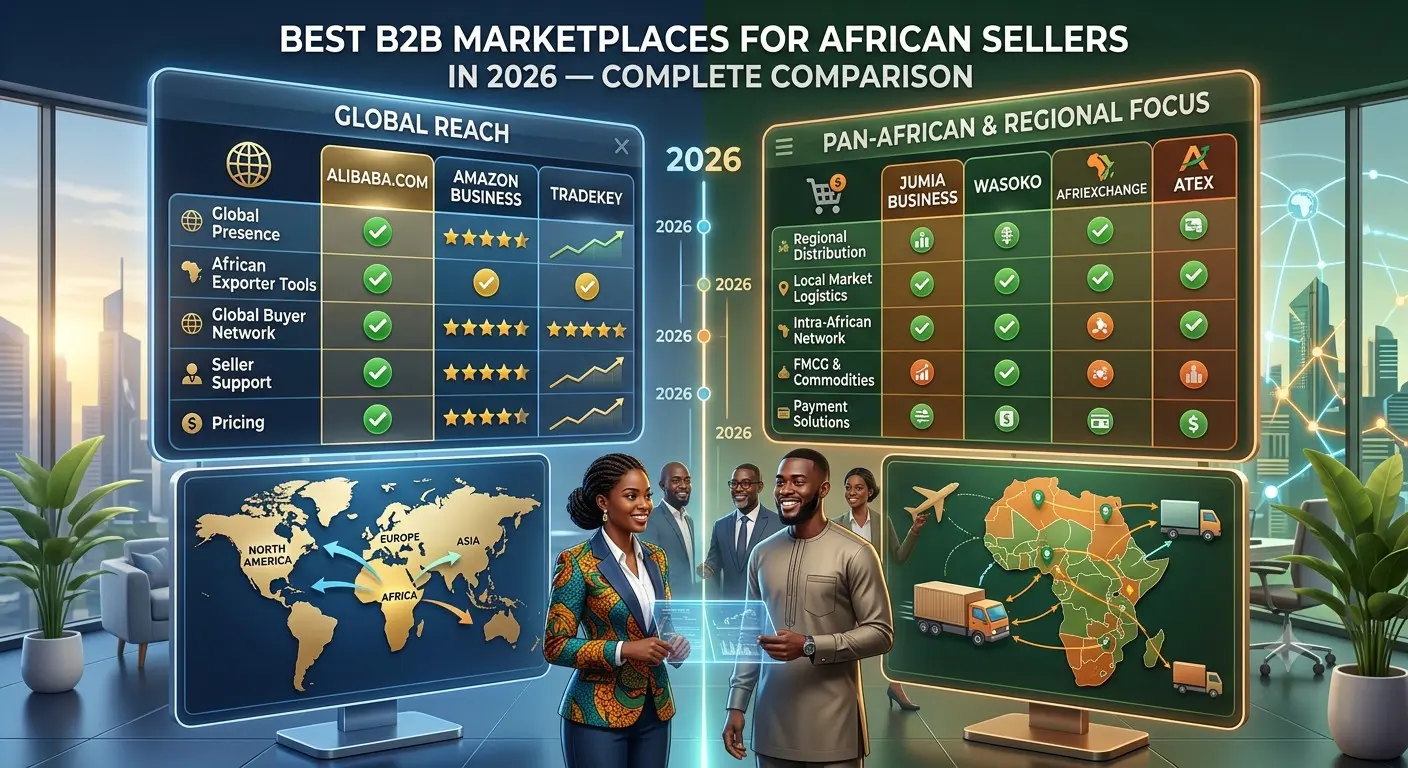
Africa’s B2B ecommerce market is forecast to grow from USD 317 billion in 2024 to over USD 1 trillion by the end of this decade. For sellers across Nigeria, Ghana, Kenya, South Africa, and the rest of the continent, that number represents one thing: the largest untapped wholesale opportunity in the world is happening right now, and the sellers who pick the right platform early will capture a disproportionate share of it.
But here is the problem. Most of the B2B marketplace guides you will find online are written for Asian manufacturers or European distributors. They recommend Alibaba, IndiaMART, and Global Sources — platforms built around Chinese and Indian supply chains — as if an Ankara fabric seller in Lagos or a macadamia nut exporter in Kenya faces the same challenges and has the same options as a factory in Shenzhen.
They don’t. And this guide won’t pretend otherwise.
This is a practical, honest comparison of the B2B marketplaces that actually work for African sellers in 2026 — covering who each platform is best for, what it actually costs, and what most comparison articles don’t tell you.
What Makes a B2B Marketplace Work for African Sellers?
Before diving into the list, it’s worth being clear about what “works” actually means for an African seller, because the criteria are different from a Chinese manufacturer’s perspective.
Relevant buyer traffic. The platform needs buyers who are actively looking for what African sellers produce — fashion, agri-commodities, beauty products, craft goods, processed food, industrial goods — not just buyers looking for cheap electronics from Asia.
Payment systems that reach African bank accounts. This rules out more platforms than you’d expect. If the payout system only works with US or European bank accounts, it effectively excludes most African sellers.
Shipping costs that make sense. Shipping from Lagos to London costs more per kilogram than shipping from Shanghai to London. A platform that doesn’t account for this — or whose buyer base expects Chinese-speed, Chinese-price delivery — will consistently disappoint both you and your buyers.
Verification and trust infrastructure. B2B buyers making large orders need to trust you. Platforms with seller verification, secure payments, and dispute resolution protect both sides and make buyers more comfortable placing large first orders.
With those criteria in mind, here is the honest breakdown.
1. Oka234 — Best Overall for African Sellers
Best for: Nigerian, Ghanaian, Kenyan, South African, and broader African sellers wanting to reach both B2B and B2C buyers globally. Free to start: Yes. Takes commission: Yes (varies by plan) Payout to African banks: Yes
Oka234 was built specifically for this gap in the market — a global marketplace designed around the African seller’s reality rather than expecting African sellers to compete as if they were Chinese factories.
What sets it apart:
Unlike Alibaba, Oka234 operates as a true hybrid B2B and B2C marketplace. You list once, and your store is visible to both wholesale buyers and individual retail customers. This matters because most African sellers are not exclusively wholesalers — they sell to businesses and individuals depending on the order size, and they need a platform that handles both from a single storefront.
The B2B pricing tools are built on B2BKing, which means you can set tiered pricing (lower per-unit price for higher quantities), minimum order quantities, quote-request functionality for large or custom orders, and buyer-group-specific pricing — the same features that make Alibaba powerful for Chinese suppliers, available to African sellers.
Key features:
- Sell to buyers in 180+ countries from a single African storefront
- Tiered wholesale pricing and minimum order quantity tools built in
- First 50 product listings handled by the Oka234 team for free — live within 72 hours
- Escrow payment protection — you receive funds only when the buyer confirms receipt
- Verified Seller badge after identity verification, which significantly increases B2B buyer trust
- Free Starter plan; paid plans unlock unlimited listings, priority placement, and a dedicated account manager
- Shipping zone system with per-class cost formulas that scale with quantity, so you never undercharge on large orders
The honest limitation: As a growing marketplace, Oka234’s buyer traffic volume is still building compared to Alibaba’s established 31 million registered buyers. However, this is also an opportunity — early sellers on a growing platform face far less competition than listing on Alibaba as the ten-thousandth seller of the same product category.
List your products on Oka234 — free
2. Alibaba.com — The Global Giant (With Real Limitations for African Sellers)
Best for: Sellers with high-volume, price-competitive manufactured goods who can absorb long sales cycles. Free to start: Limited free tier; paid Gold Supplier plans from ~$2,000/year. Payout to African banks: Via bank transfer (complex for many African countries)
Alibaba.com stands out as the premier platform for international wholesale trade, catering to millions of buyers and suppliers across the globe. That reach is real — and for the right seller, it is unmatched.
But here is what the comparison articles don’t say clearly: Alibaba was built for and by Chinese manufacturers. The platform’s search algorithms, buyer expectations, and pricing assumptions are calibrated around Chinese production costs. An African seller listing natural shea butter or handmade Ankara bags is competing in a marketplace where buyers default to filtering by “China” first.
Where Alibaba works for African sellers:
- Agricultural commodities (sesame seeds, cashews, cocoa, shea) where buyers are actively sourcing from Africa specifically
- Large-volume manufactured goods where African pricing is genuinely competitive
- Sellers with a significant marketing budget and patience for a 6–12-month ramp-up period
Where it doesn’t:
- Handcrafted, fashion, or unique cultural products where African origin is an advantage — Alibaba’s structure doesn’t surface this well
- Small to mid-sized sellers without the budget for a Gold Supplier subscription
- Sellers whose products have minimum orders below what Alibaba’s B2B buyer base expects
3. Jumia Business — Best for Intra-African B2B
Best for: Sellers wanting to reach business buyers within Africa (West and East Africa primarily). Free to start: Registration-based. Payout: Via local payment methods per country
Jumia is the pan-African e-commerce platform with the broadest geographic reach on the continent, operating in 11 countries across West Africa (Nigeria, Côte d’Ivoire, Senegal, Ghana), East Africa (Kenya, Uganda, Tanzania) and North Africa (Morocco, Egypt, Algeria, Tunisia).
Jumia’s B2B offering is less well-known than its consumer marketplace, but for sellers wanting to reach business buyers within Africa rather than internationally, it is worth considering. The local logistics infrastructure and brand recognition in key markets (Nigeria, Kenya, Egypt) mean delivery times and buyer trust are more reliable than on platforms without local presence.
The limitation: Jumia is primarily a consumer platform. Its B2B capabilities are not as developed as dedicated B2B marketplaces, and its buyer base is predominantly retail rather than wholesale. If your goal is international wholesale buyers, Jumia is the wrong platform.
4. AMBESA — Pan-African B2B Specialist
Best for: Sellers focused on intra-African B2B trade, particularly SMEs. Free to start: Yes. Payout: Via African bank accounts
AMBESA.com is the leading Pan-African B2B E-Commerce Marketplace designed to bridge the gap between African businesses. The platform empowers Small and Medium Enterprises (SMEs) across Africa by connecting them with buyers and sellers in key industries.
AMBESA fills a specific gap: African-to-African B2B trade. If your primary buyers are other businesses within Africa — retailers, distributors, manufacturers sourcing inputs — AMBESA’s buyer base is more targeted than a global platform where African buyers are a small minority.
The platform is less useful if you are trying to reach buyers in Europe, the US, or Asia. But for pan-African wholesale, it is purpose-built in a way that global giants are not.
5. Amazon Business — High Barrier, High Reward
Best for: Sellers with branded, unique products (especially natural beauty and niche food) willing to invest 6–12 months in building Amazon presence. Free to start: No — significant setup requirements. Payout to African banks: Via Payoneer or Hyperwallet (not direct)
Amazon launched its South African marketplace in May 2024 — its first dedicated storefront in Sub-Saharan Africa — and immediately became a major competitive force. In its first year, Amazon recruited over 10,000 sellers in South Africa.
For South African sellers specifically, Amazon’s local marketplace is now a legitimate option that didn’t exist 18 months ago. For Nigerian, Ghanaian, and other West/East African sellers, Amazon Global Selling remains the relevant route — listing on Amazon US or UK.
The honest reality: Amazon rewards sellers who understand Amazon SEO, invest in advertising, and can handle returns efficiently. The learning curve is steeper than any other platform on this list, and the competition from established Chinese sellers in most categories is fierce. The sellers who succeed on Amazon from Africa typically have a truly differentiated product — something buyers cannot easily source from China.
6. Global Sources — For Large-Volume Exporters
Best for: Manufacturers and large-volume exporters in electronics, textiles, and industrial goods. Free to start: No — verified supplier listings require paid membership. Payout: Via international bank transfer
Global Sources serves serious international B2B buyers — importers, large retailers, procurement managers — who source in significant volume. It hosts regular trade shows (Hong Kong is the flagship) alongside its online marketplace. For an African manufacturer of textiles, agricultural machinery parts, or processed food products operating at scale, Global Sources is a credible channel to serious international buyers.
The barrier is cost and volume expectations. Global Sources buyers expect factory-level minimum orders. This is not the right platform for sellers in the early stages of export.
Comparison at a Glance
| Platform | Best For | African Seller-Friendly | Cost to Start | B2B + B2C? | International Buyers? |
|---|---|---|---|---|---|
| Oka234 | All African sellers, B2B + B2C | ✅ Built for Africa | Free | ✅ Yes | ✅ 180+ countries |
| Alibaba | Large-volume manufacturers | ⚠️ Competitive vs China | $2,000+/yr | B2B only | ✅ Global |
| Jumia Business | Intra-Africa B2B | ✅ Strong Africa presence | Free | ⚠️ Mostly B2C | ❌ Africa only |
| AMBESA | Pan-African SME trade | ✅ Africa-focused | Free | ✅ Yes | ⚠️ Africa-focused |
| Amazon Business | Branded/unique products | ⚠️ High complexity | Variable | B2B + B2C | ✅ Global |
| Global Sources | Large exporters | ⚠️ Volume expectations | Paid | B2B only | ✅ Global |
Which Platform Should You Start With?
The honest answer depends on where you are in your business and what you sell.
If you are just starting international selling — start with Oka234. Zero cost, your first 50 listings handled for you, and a platform built around your reality as an African seller rather than expecting you to compete as a Chinese factory. The fact that it handles both B2B and B2C from one storefront means you generate retail revenue while building your B2B buyer base simultaneously.
If you have a genuinely unique branded product (natural beauty, specialty food, handcraft) — add Etsy or Amazon alongside Oka234. These platforms have established buyer communities that actively seek African-origin products and will pay a premium for authenticity.
If you are a large-volume manufacturer with export-ready production capacity and a budget for platform investment — Alibaba and Global Sources are worth the investment, with the understanding that you are playing a long game and competing in a crowded field.
If your primary market is other African businesses — AMBESA and Jumia Business are the most targeted options, though Oka234’s Africa coverage and lower entry barrier make it a strong complement to either.
The One Mistake Most African Sellers Make on B2B Platforms
They list and wait.
A B2B marketplace listing is not a passive income stream. The sellers generating consistent wholesale revenue across every platform on this list share one behaviour: they respond to inquiries within hours, not days. They price clearly with tiered options visible upfront. They have real product photos, accurate weights, and real shipping cost estimates.
B2B buyers are comparing suppliers simultaneously. The first professional, clear, well-priced response wins the order. The seller who responds 3 days later with a vague reply loses it — even if their product is better.
Set up your store properly. Price clearly. Respond fast. Then the platform works for you.
Getting Started
The fastest path to your first international B2B order in 2026:
- Create a free seller account on Oka234 — the Oka234 team lists your first 50 products for you, live within 72 hours. Start here →
- Set tiered pricing from day one — show buyers the per-unit price for 10 units, 50 units, and 100+ units. This is the single biggest signal to a B2B buyer that you are a serious supplier.
- Complete KYC verification — get your Verified Seller badge. B2B buyers placing large first orders need this reassurance.
- Get real shipping quotes from DHL or Speedaf for your main product and top destination countries. Use real numbers in your shipping rates — buyers check.
- Set a response time goal of under 4 hours during business days. The sellers who respond fastest win the most B2B orders, period.
Oka234 is a global B2B and B2C marketplace connecting African sellers to buyers in 180+ countries. Create your free seller account today.